Tuesday, May 13, 2014

2-20 Four Horses


Herd of Running Spirit Horses - by: Deirdre McCay


Dear Readers,

Because the horses of the Black Hawk Conflict played such an important role in the next portion of this journey, I am taking a brief side trip to honor the spirit of the horse, for its contributions to and sacrifices for the people it chooses to serve.


In 1519 Cortes and his Conquistadors brought 15 horses to Mexico, reintroducing a species that had gone extinct on the continent between 8,000 and 10,000 years ago.  Within one hundred years, the population of horses numbered in the millions.

It is believed that Native Indians (Incas, Aztecs, and Mayans) adopted horses as allies almost immediately upon being introduced to them in battle.  The Spanish, with their superior speed, stronger weapons (Spanish Steel was much stronger than anything being used by the Native Americans), and hounds of war (Mastiffs and Great Danes trained to kill), were able to overwhelm much larger numbers of Native Indians.  Prior to this time, native people used llamas as pack animals and for transportation, but the horses were a clearly superior animal, and it was not long before escaped and stolen horses found their way into Native Society.


Horses impacted Native American culture in three important ways:

  1. With horses, the Indians were now able to hunt buffalo much more successfully.  As a result, the Indian diet and culture changed.
  2. Horses were an important source of wealth and status, and became a highly valuable trade good item.  Tribes with many horses were highly esteemed and feared by those without.
  3. Horses were strong and fast, which enabled the migratory Indians to range further between winter and summer lodges, effectively increasing their territory.

By the early 1800s, horses had become an inseparable part of Native Indian culture.  They had become a living standard of currency, while simultaneously being indispensable as a means of travel.  To the Sauk and Meskwaki, whose familiar territory ranged from Texas to Canada, horses were an integral part of life itself.  It was because of their horses that Black Hawk and his warriors were able to stage raids so far away from the main host of their band, baffling their pursuers as to their whereabouts and direction of travel.


Wild Spirits Horse - by: Marianne Caroselli


I wanted to take some time to honor the spirit of the horse for a lifetime of service and friendship to the Native American people.  The horses of the Black Hawk Conflict suffered nearly as much as their riders, being ridden to exhaustion and sometimes, as in the case of the soldier's mounts, to death.


In his Autobiography, during the description of the Battle of Wisconsin Heights, Black Hawk mentions his horse twice. “I was mounted on a fine horse…”; “My horse, having been wounded twice during this engagement…”  The white soldiers even described the horse in their recollections; “Their commander … was on a white pony on the top of a mountain…”  How remarkable must this animal have been, if amid all the fighting and terror, both sides of the conflict pay homage to the memorable presence of Black Hawk's horse?

Between the Battle of Wisconsin Heights and the Bad Axe Massacre, the soldiers describe finding the carcasses of several horses in the Indian encampments.  These horses had given their lives aiding and protecting their riders, and at the end gave even of their flesh.


Breaking Dawn Indian War Horse - by: Marcia Baldwin


  • A horse is a living spirit, like people are living spirits.
  • Horses need to be recognized, honored and remembered for their contributions and sacrifices.
  • Today, we pay tribute to the spirit of the horse, for being a friend to Native Indians.
  • Horse spirits give of themselves, to help and serve people.
  • A horse is a thinking being that chooses to give help – that chooses to offer itself in life and death – that chooses to love The People it cares for and serves.


Spirit Horse - by: Dawn M. Becker


I am going to share with you an event that in a very real way has influenced my spiritual journey.  I include it here, though the deeper meaning may be lost to some readers.

Last fall, I had a dream in which I was visited by an Indian spirit named Morning Star and her horse. She told me that the horse would help lead me through my journey.  I remember that her spirit horse was cream color, with brownish markings, had a thick neck, and a great barrel chest.

In mid-December, I wrote to my friend Joni, telling her about my dream.  She had been talking about my journey with a friend of hers, named Jean, who owns horses.  Joni wrote back to me saying that her friend has four horses, by the names of Jewel, River, Lily and Canyon.   One in particular, Lily, has a shape and markings similar to the horse I had seen in my dream.  Through Joni, Jean let me know that she had spoken to her horses and encouraged them to visit my dreams and guide my journey.


A Dream of Four Horses

The next night I had another dream in which I was visited by Four Horses, each with a different message. They did not speak to me with words, but rather through dream language, without speech.

Majestic Horse - by: Marcia Baldwin

The First Horse told me that The People would like to go home down the Great River (which I understood to mean the Mississippi), not by the path they had come on. That path is filled with sorrow and hopelessness.  The People say, “We want to follow the Great River to our home, so we can have fun and laugh.  You will take us home by the Great River”. 
This surprised me, because it was my intention to walk their path from the Wisconsin River back to Saukenuk, a trip that I had already started.  This caused me to reconsider what the Spirits wanted, rather than thinking only about what I wanted to do.


Spirit of a Horse - by: Marcia Baldwin

The Second Horse said, ‘But first, You must travel the path of The People, from Saukenuk to the Bad Axe River. You must learn Their story.  “You must know us and tell our story to others, so we will be remembered."'

This was when I knew that my journey must follow a different path than I thought it would.  Until then, I thought my journey would go from the Battle of Wisconsin Heights back to Saukenuk.  Now I knew I must travel Their path, in the correct direction, from beginning to end.  Only then could I follow the meandering turns of the Great River, to take The People home.


Spirit Eye Indian War Horse - by: Marcia Baldwin

The Third Horse spoke in a soft whisper, like leaves that rustle in a gentle wind.  This was a Spirit Horse.  It did not speak to my mind, it spoke to my soul.  It said I shouldn't worry or feel uncertain about the path I must take.  This horse told me that it will guide my spirit when my mind can’t hear.  It will help me follow the right path when others won’t or can’t help me. When I am lost or uncertain, I should be still and listen to the whispers of my soul.


Encounter with a Spirit Horse - by: Deidre McCay


The Fourth Horse did not speak.  Even so, I understood a message:  "I will speak when you have finished walking the path of The People, learned Their story, and shared what you have learned with others.  Then, I will travel with you to take The People home."


I awakened with the words of these Four Horses filling my mind, as clear to me as though they had spoken them aloud.  Everything about the path I needed to travel had changed, and I was suddenly filled with joy and excitement.  With absolute certainty, I knew that I was ready to begin the final preparations for my journey.  I now had a clear starting point and destination.  I now had a clear purpose.  It was time to begin.


Spirit Horse


Spirit Horses – many times I have called upon you for help and clarity.  Many times you have responded and given me your wisdom and guidance, but never more clearly than when you have spoken to me in my dreams.  I was going to walk Their path backwards, because it was easier for me, but you corrected me.  Thank you for guiding my steps and for opening the hearts of people who can teach me the proper ways.  I was going to start and stop my journey in the wrong places.  You told me what was right.  I was uncertain of myself and worried that I didn't know the right path to follow.  You told me to listen to my soul, and you would whisper to me, telling me where to go.  You set my mind at ease and helped me to feel the right way, both in my mind and in my heart.

Spirit Horses - I call to you still.  I ask for your continued guidance.  I ask you to visit my dreams once again, when the first part of my journey is complete, and I am ready to take The People home.  My heart is open, my mind is ready, and my soul is waiting.
Ah-ho.


Wild Horses - by: Sainasan


(Key Terms: Ma-Ka-Tai-Me-She-Kia-Kiak, Black Sparrow Hawk, Black Hawk, 1767, Saukenuk, Pyesa, Rock Island, Black Hawk’s Watch Tower, Black Hawk State Historic Site, Hauberg Museum, Sauk, Sac, Meskwaki, Fox, Rock River, Sinnissippi River, Mississippi River, War of 1812, British Band, Great Britain, Treaty of 1804, Treaties, Ceded Land, William Henry Harrison, Quashquame, Keokuk, Fort Armstrong, Samuel Whiteside, Black Hawk War of 1832, Black Hawk Conflict, Scalp, Great Sauk Trail, Black Hawk Trail, Prophetstown, Wabokieshiek, White Cloud, The Winnebago Prophet, Ne-o-po-pe, Dixon’s Ferry, Isaiah Stillman, The Battle of Stillman’s Run, Old Man’s Creek, Sycamore Creek, Abraham Lincoln, Chief Shabbona, Felix St. Vrain, Lake Koshkonong, Fort Koshkonong, Fort Atkinson, Henry Atkinson, Andrew Jackson, Lewis Cass, Winfield Scott, Chief Black Wolf, Henry Dodge, James Henry, White Crow, Rock River Rapids, The Four Lakes, Battle of Wisconsin Heights, Benjamin Franklin Smith, Wisconsin River, Kickapoo River, Soldier’s Grove, Steamboat Warrior, Steamship Warrior, Fort Crawford, Battle of Bad Axe, Bad Axe Massacre, Joseph M. Street, Antoine LeClaire, Native American, Indian, Michigan Territory, Indiana Territory, Louisiana Territory, Osage, Souix, Potawatomi, Ojibwe, Ottawa, Ho-Chunk)


Friday, May 9, 2014

2-19 Oh, Great Wisconsin Waters!


April 13, 2014 
Wisconsin River
Sauk City, WI


“Here some of my people left me, and descended the Ouisconsin, hoping to escape to the west side of the Mississippi, that they might return home. I had no objection to their leaving me, as my people were all in a desperate condition. Being worn out with traveling, and starving from hunger. Our only hope to save ourselves, was to get across the Mississippi. But few of this party escaped. Unfortunately, a party of soldiers from Prairie du Chien, was stationed on the Ouisconsin, a short distance from its mouth, who fired upon our distressed people. Some were killed, others drowned, several taken prisoners, and the balance escaped to the woods and perished with hunger. Among this party was a great many women and children.”

– Black Hawk, in his Autobiography


Large, rivers are dangerous places. Every year, people drown in the Wisconsin River, disarmed by its shallow sandbars and modest banks. Beneath the placid surface, however, lies a treacherous undertow, quicksand, and deadly snags. When the Sauk, Meskwaki and Potawatomi of Black Hawk’s dwindling band reached its banks on the night of July 21st, they were literally starving to death, and exhausted from days of relentless racing across the territory. With the enemy at their heels, they had but one choice, cross or die. In the end, the choice made for little difference.


During the night, some 200 of the weakest and least able to travel by foot split off from the main band and headed south in makeshift elm bark canoes and rafts.  The vast majority of these were women and children, with a few men.  The canoes were flimsy and unstable, and some of the travelers drowned in their escape attempt.  Those who did not drown met with a worse fate down the river.  When Colonel Dodge was told that some of the Indians were in flight down the Wisconsin, he hurriedly sent an express message to Captain Gustavus Loomis of Fort Crawford, encouraging him to arrange to stop any who may seek to escape in that way.  The response was to anchor a large flatboat on the river with a six-pound cannon and twenty-five soldiers, and putting eight more men upriver at the ferry crossing.  Second Lieutenant Joseph Ritner was put in charge of those operations.

On the night of July 28th, sometime around 2 am (making it officially the 29th), the Ferry Guard saw and fired upon a number of canoes, killing at least one Indian.  Five canoes were reported abandoned, with the people swimming to shore and fleeing into the woods.  Further downstream, Ritner’s troops fired upon three or four more canoes, killing nearly all in the melee.


Joseph Ritner


Gustavus Loomis
In the book, Black Hawk: The Battle for the Heart of America, author Kerry A. Trask wrote that when daylight broke, “The steamboat Enterprise, outfitted with a cannon, was sent to patrol up and down the Wisconsin, while bands of Winnebago and Menominee warriors were sent out to hunt down any Sauk refugees who may have gone ashore.  The Indian mercenaries searched the riverbanks and woods by day and then at night by torchlight, and soon began returning with fresh scalps and prisoners.”  In the book, Trask quotes a letter written by Joseph Street to William Clark.  ‘The prisoners are the most miserable looking poor creatures you can imagine.  Wasted to mere skeletons, clothed in rags scarcely sufficient to hide their nakedness. Some of the children look as if they had starved so long they could not be restored.’  In the book, Trask continues, “By August 8th, the Galenian informed its readers that the operations on the lower Wisconsin has “resulted in about 34 prisoners, 50 killed, chiefly women and children.”


I have spent an uncharacteristically small amount of time during this post talking about my journey, and describing my observations and feelings.  What exactly can be said?  How do you properly place into a familiar frame of reference the mental picture of emaciated, naked women and children being fired upon in the night with cannons and muskets, the survivors then hunted and scalped?  Is it possible to think of the condition of these poor people without recalling the nightmarish photos of Jewish holocaust victims lined up along barbed wire fences, or laying heaped upon one another in trenches?  I am utterly unable to expose my deepest feelings using mere words, so black and primal are their nature.

I stand at the edge of the river and gaze across its broad, flat surface, letting the passing waters heal my mind.  Only hope, and love, and time will enable me to recover the injury to my spirit caused by this tragedy.  I’m not sure I’ll ever be able to completely forgive.


Oh, Great Wisconsin, waters of my youth – Oh, Great Ouisconsin, waters of the Sauk and Ho-Chunk – Oh, Great Ouisconsing, waters of the French traders – Oh, Great Mescousin, waters of the Miami – Oh, Great River that flows for all men, be they red, white, yellow or black – many are the names you are given, and heavy is your burden.  We ask you to bring life to the plants and animals of the land.  We ask you to give a home to the fishes and the birds.  We ask you to mark our path, so that we do not lose our way.  We ask you to carry us, and our belongings upon your back.  We ask you to give of your very essence, even in the face of the most severe drought, bringing that which is most precious to our survival.  Most unfairly of all, we ask that you carry away our filth, our refuse, and our dead.  How mighty must your Manitou be to do all these things and more?  It seems there is no end to the gifts you offer.  I am deeply grateful to you, Great Red Stone River, for washing clean the foul deeds of man, forever giving us the opportunity to start each day anew.  I have bathed in your arms, I have eaten of your bounty, I have traveled your reaches, and I have flown over your shining surface like a bird when you came to me in my dreams.  Your water is in my blood, and my blood will someday return to your waters.  Please accept my token of healing, that you may recover from the wounds we have inflicted upon you.  Please find the spirits of those who may still linger on your banks and guide them down your flowage to their homes.  Please carry away the tears I give You now, and use them to nourish, cleanse, and heal those along your path.  Ah-ho.


(Key Terms: Ma-Ka-Tai-Me-She-Kia-Kiak, Black Sparrow Hawk, Black Hawk, 1767, Saukenuk, Pyesa, Rock Island, Black Hawk’s Watch Tower, Black Hawk State Historic Site, Hauberg Museum, Sauk, Sac, Meskwaki, Fox, Rock River, Sinnissippi River, Mississippi River, War of 1812, British Band, Great Britain, Treaty of 1804, Treaties, Ceded Land, William Henry Harrison, Quashquame, Keokuk, Fort Armstrong, Samuel Whiteside, Black Hawk War of 1832, Black Hawk Conflict, Scalp, Great Sauk Trail, Black Hawk Trail, Prophetstown, Wabokieshiek, White Cloud, The Winnebago Prophet, Ne-o-po-pe, Dixon’s Ferry, Isaiah Stillman, The Battle of Stillman’s Run, Old Man’s Creek, Sycamore Creek, Abraham Lincoln, Chief Shabbona, Felix St. Vrain, Lake Koshkonong, Fort Koshkonong, Fort Atkinson, Henry Atkinson, Andrew Jackson, Lewis Cass, Winfield Scott, Chief Black Wolf, Henry Dodge, James Henry, White Crow, Rock River Rapids, The Four Lakes, Battle of Wisconsin Heights, Benjamin Franklin Smith, Wisconsin River, Kickapoo River, Soldier’s Grove, Steamboat Warrior, Steamship Warrior, Fort Crawford, Battle of Bad Axe, Bad Axe Massacre, Joseph M. Street, Antoine LeClaire, Native American, Indian, Michigan Territory, Indiana Territory, Louisiana Territory, Osage, Souix, Potawatomi, Ojibwe, Ottawa, Ho-Chunk)


Thursday, May 8, 2014

2-18 Wisconsin Heights - The Great Escape


April 13, 2014
Wisconsin Heights Battle Site
Roxbury, WI


I feel it is important to reintroduce myself, and talk about the purpose of this web log. My name is Theresa Jansen, and I am descended from an Ojibwe Native American, though my grandmother's name and the tribe of my ancestry, has been lost to me. I am in the process of taking a journey, both spiritual and physical, following the path taken by the Sauk warrior Makataimeshekiakiak, also known as Black Sparrow Hawk, leader of the native people caught up in the conflict known as ‘The Black Hawk War’ of 1832. The story is at once both tragic and inspiring, but above all, shameful to those of us who think of ourselves as proud Americans living in a land of freedom, individual rights, equality, and justice. 


It is here, nestled in the hills of the Mazomanie Oak Barrens State Natural Area just south of Sauk City, Wisconsin, that I first engaged the trail of Black Hawk and his band.  Why here? Well, there is a lot to that story. Believe me when I tell you this blog isn't even the half of it. 

I will, as with my other posts, tell you about my visits to this location, and recount the story of Black Hawk and his people as they passed through.  I will talk about their pursuers, the militia forces led by commanders Dodge and Henry.  I will give you my thoughts and reactions, and lastly my prayers, but first I will try to explain again how this all came about.

I have finally reached the part of my journey where it began, so to speak.  As I already stated in my post Following Black Hawk’s Trail, I have spent all my life in Wisconsin, and have felt drawn to this particular area of the state for many reasons.  (If you have not read that post, I encourage you to do so now, and then return to finish reading this one.)  As a child, my family would take trips driving through this region, and my father would tell us stories about our ancestors, who had lived in the area - a great-great uncle here, or a great grandfather there.  I was young, and I didn't listen closely enough while I had the chance.  Now, I must undertake the journey without him.  The folly of youth, the wisdom of years, a moment of pride, a lifetime of tears.

The stories I did listen to, however, were about my Native American grandmother.  I have spent long hours pursuing documents through dusty archives, church basements, and online vaults, visiting cemeteries, and asking family members what they know or remember.  I have had DNA testing performed, to verify my Native American heritage, and ordered countless documents from vital records departments.  More than once I have despaired at the difficulty of finding documented information about my Indian ancestry, so that I might know my Indian grandmother's name, tribal affiliation, and clan.  Nevertheless, I keep digging.


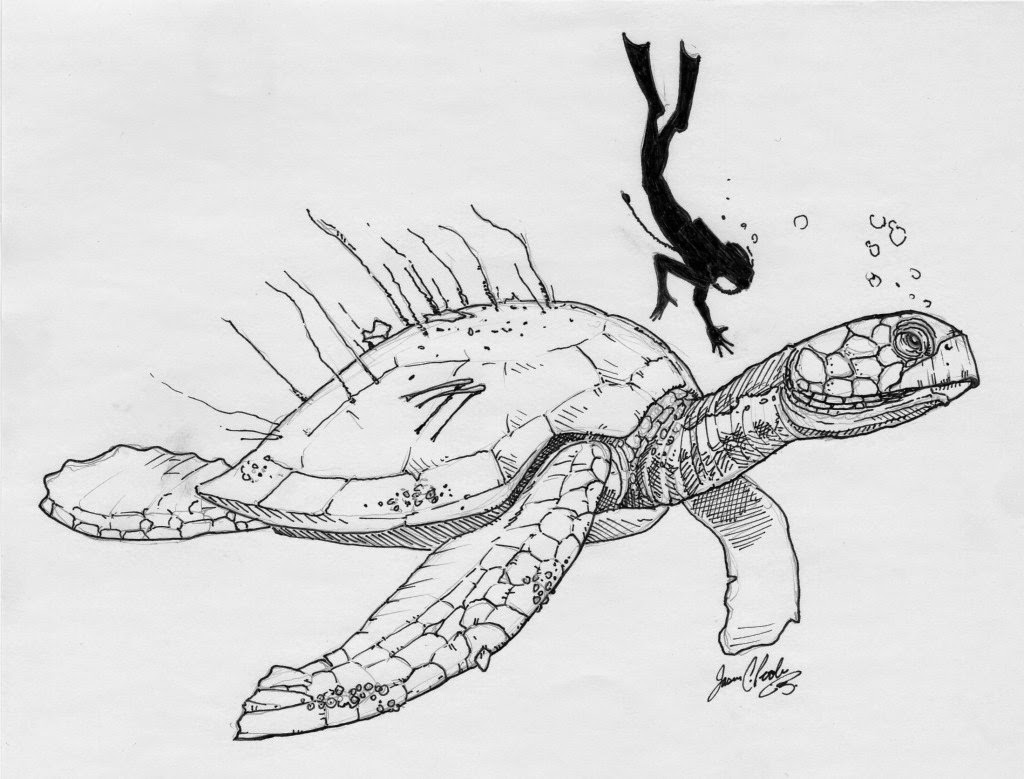
Atlantochelys Mortoni Humerus Bone


I recently read the story of a fossilized turtle bone, which was from the upper right flipper of an Atlantochelys Mortoni.  In 1849, the naturalist Louis Agassiz found a broken piece of bone which he identified as a unique species, some 75 million years old.  No complete skeleton of one of these massive, extinct sea turtles has ever been found.  In fact, no other bones have ever been found which could clearly be identified as belonging to the mysterious giant – until now.  In 2012 an avocational paleontologist by the name of Gregory Harpel was rooting around the Monmouth Brooks region of New Jersey and happened across a fossilized bone.  He took it to an expert who recognized it as belonging to a very large turtle, and then laughingly remarked that it might even be the long-lost missing half of the bone discovered by Agassiz 163 years earlier.  Of course, what made this story so fantastic was that the two halves of the bone did indeed fit together – a perfect and undeniable match.  By finding the second half of the only known bone in existence for this species of animal, it was now possible to calculate the approximate size of the turtle – an astonishing 10 feet, making it one of the largest known species of turtle – which was not possible to any certain degree with only half a bone.


I tell this story not just because it is fascinating to me, but because it demonstrates how people, events, and even things that are separated by dozens or hundreds of years can suddenly merge together to form a complete and compelling story.

My story is not so spectacular, but it is similar in nature.  While living in the Cross Plains area, in the early 1980's, I was overwhelmed by the sense that a great battle had taken place nearby, and that many Indians had been killed.  I asked around, but no one was able to remember any battles that had taken place in or around Cross Plains.  Somebody thought there had been a fight between some soldiers and some Blackhawk Indians and maybe some Kickapoo Indians a long time ago, but they didn't know anything else about it.

Decades later, a friend of mine, Joni, after hearing some of my stories, said that the event sounded a lot like the Battle of Wisconsin Heights, so she sent me a hyperlink to some historical archives.

Like a Jules Verne traveler, I felt like I was caught in the outer edge of a vast temporal vortex whose center was the two large hills near the banks of the Wisconsin River where this battle was fought.  I learned, to my utter shock, that the battle had taken place on land that was once owned by my Great, Great, Great Grandfather, Kaspar Hornung.  More, I discovered that this was the branch of the family tree from which my Native American ancestry originated.  Suddenly the random puzzle pieces started to form a picture.  I felt a sensation not unlike vertigo.


Hornung Homestead
Site of Battle of Wisconsin Heights
(Black Hawk Mound in background)
I traveled to this piece of land, and discovered the original family homestead, with one of the early homes still standing.  My ancestor did not immigrate to this country until 1846, and therefore, did not participate in the 1832 conflict, but he, Kaspar, was the first white settler to build and farm on this bloodied battleground.  

The more I learned about the Battle of Wisconsin Heights and Black Hawk himself, the more intrigued I became with his story.  I came seeking a connection to my genealogical roots, and I discovered a story so compelling and so completely in touch with that invisible yearning in my soul that I immediately undertook the mission to pursue the history and  publish this story in a way that connected the loose fragments of my life, discovered through time, into a new and more complete narrative.

I do not pretend to be telling a story that has not been written before, nor do I believe that I hold some vital clue which now makes it possible for a great advancement in historical knowledge and perspective.  Indeed, there are an incredible number of books, articles, museums, statues, memorials and other websites that hold an astonishing amount of detail about Black Hawk’s fated journey.  It is my hope, however that in this web log the story is told in a way that no one else has told it, and perhaps I have added one or two new pieces to the whole.

I have visited the site of the battle many times over the past year.  While seeking to learn more about my Indian heritage, and to practice some of the spiritual ceremonies I have been learning from my Native American friends.  I came to this land to commune with the people who died here, to remember them, honor them, and give them offerings of food and tobacco.  While my German ancestors were not directly responsible for driving Black Hawk's people from these hills, I have come to realize that their very presence here contributed to the downfall of the indigenous societies in this area.  My European ancestors and others like them saw nothing but an unclaimed land that was their's for the taking.  Relentless greed and consumption created an unstoppable force that swept the Native Americans from their homes.  It is no different than the melting of the polar ice caps.  We all see it happening.  We all know it’s bad.  We all know it will ultimately lead to the destruction of much of our earth.  We all sit quietly and wish it could be different.  We all keep doing all the things we have always done that created the problem in the first place.

On one of my visits to the battle site, I brought my family with me, four generations of cousins who share German/Native American ancestry.  We walked the trails up to the effigy mounds.  We talked about Kaspars’s farm.  We also talked about the battle, and the people who died here.  I know the names of only two of the people actually buried on the site.  The first is Mary (Hornung) Hackett, a young girl who was buried here long after the battle took place.  The second is Thomas Jefferson Short, the only white casualty of the battle, buried on the same knoll as Mary, though I do not know for certain which knoll.  There are Indians buried here as well.  The burial mounds can still be visited today by walking a short trail up the hill from the parking lot on Hwy 78.  (If you visit this site, please show respect or our Native American brothers and sisters, and do not walk on the top of the mounds.)  The mounds are said to be over a thousand years old.  I have been unable to confirm the accuracy of this assertion, since the historian at the Sac and Fox Nation does not know whether these mounds are Ho-Chunk or Sac.  As to what became of the bodies of the estimated sixty-eight Indians who died here that soggy day in July, 1832, nothing is certain, except to say that at least 35 were scalped by the white soldiers and the Winnebago Indians who had been fighting alongside them.  Colonel Dodge also stated that the Sauk were seen carrying the bodies of the fallen away from the battlefield, and some accounts have suggested that the dead were released to the great river to carry them downstream, back to the land of their birth.

On another one of my visits, I was joined by Joni and my husband, who walked with me from the edge of the Wisconsin River back to the battle site.  At the river, we sang to the water and to the spirits of the people, telling them we were here to remember their bravery and their sacrifice.  As we walked, we talked about the journey I was planning, but had not yet started in earnest.

Other times I came just by myself.  I walked the land, and made small fires for meditation and healing.  I spoke to the spirits and I prayed for them.  I prayed that they would be able to let go of their anger, it was bad for their spirits, it was bad for the land.  I asked them to follow the smoke from my fire and find contentment and joy in the land of the spirits.  I spoke gently, telling them it was time for them to find peace.  This land became the center of my journey.  A seed grew within me here.  On this land I found my Grandmother.  On this land I found myself and the fruit of that vine is written on the pages of this blog.


***********************************************************************************************

When I arrived at the battle site today, it was raining steadily, just as it had been in 1832.  I parked by the Historical Marker, which gives a more-or-less accurate summary of the events.  The marker reads:


“On July 21, 1832, during a persistent rainstorm, the 65-year old Sac Indian leader, Black Hawk, led 60 of his Sac and Fox and Kickapoo warriors in a holding action against 700 United States militia at this location.  The conflict, known as the Battle of Wisconsin Heights, was the turning point in the Black Hawk War.  Here commanders General James D. Henry and Colonel Henry Dodge and their troops over-took Black Hawk and his followers after pursuing them for weeks over the marshy areas and rough terrain of south central Wisconsin.  Yet because of Black Hawk's superb military strategy, the steady rain, and nightfall, approximately 700 Indians, including children and the aged, escaped down or across the Wisconsin River about one mile west of here.  Their success was short-lived.  The war ended just 12 days later at the Battle of Bad Axe when many of Black Hawk's followers drowned or were slain in their attempt to cross the Mississippi River.”

The fighting started at approximately three o’clock in the afternoon, when the troops finally caught up to some of Black Hawk’s warriors.  Several small skirmishes and feints broke out, and the soldiers kept advancing after each.  By five o’clock, the battle started in earnest.  In his autobiography, Black Hawk states:


“Ne-a-pope, with a party of twenty, remained in our rear, to watch for the enemy whilst we were proceeding to the Ouisconsin, with our women and children.  We arrived, and had commenced crossing them to an island, when we discovered a large body of the enemy coming towards us.  We were now compelled to fight, or sacrifice our wives and children to the fury of the whites!  I met them with fifty warriors (having left the balance to assist our women and children in crossing), about a mile from the river when an attack immediately commenced.” 
Black Hawk goes on to state:
“I would not have fought there, but to gain time for my women and children to cross to an island.  A warrior will duly appreciate the embarrassments I labored under – and whatever may be the sentiments of the white people, in relation to this battle, my nation, though fallen, will award to me the reputation of a great brave in conducting it.”

I am fascinated by many things.  Foremost is the observation that Black Hawk immediately recognized that despite the loss of life, and the eventual rout by the soldiers in forcing them from their position, this was a truly remarkable victory on the part of the Sauk warriors.  Whether it was fifty warriors, as Black Hawk suggests, or even a hundred, he was vastly outnumbered by the more than 700 soldiers aligned against him.  Yet somehow he managed to defend territory for over an hour and achieve his goal of enabling his people to escape.  As he predicted, the white soldiers who fought there considered it a major victory themselves, because the loss of life was so dramatically one-sided, with only one soldier killed and eight wounded, compared to sixty or more Indians killed.  Those who have studied the battle in retrospect, however, have great admiration for the strategy and tactics Black Hawk used in commanding his forces.

Another thing that fascinates me is how little space Black Hawk affords to his recollection of the battle.  In one sentence, he passes from taking a position high on the hill, to have an advantage over the whites, to, “But the enemy succeeded in gaining this point, which compelled us to fall back into a deep ravine, from which we continued firing at them and they at us, until it began to grow dark.”  The entire battle was told in two sentences.  As dusk fell, he gave the order to his warriors to disburse and meet back at the Wisconsin River, by different routes, where he was “astonished to find that the enemy were not disposed to pursue us.”

This is in great contrast to the volumes and pages of material that were written by the soldiers and their commanders on the same subject.  They go into great and painstaking detail to describe who was fore and who was in the rear, who was left and who was right, who shot and who got shot, where they were at the moment of the charge, where the horses were kept, and what orders were given by whom.  Paintings have been made of the battle site.  Maps have been drawn and published.  Detailed charts of command have been rendered, and newspaper articles written commemorating the event.  Nearly two hundred years later it is possible to study nearly every detail of the fighting, to the degree that one can stand with great certainly in the place where each squadron held their positions, and picture with ease the various attacks and retreats.  To Black Hawk, this was just another skirmish in his long and storied military history.  To the soldiers, it was finally the fight they had been seeking for months, and they wanted to record every last detail for posterity.

The entire battle at the site is said to have lasted approximately an hour and a half, through cold rain and an easterly wind, with low, heavy clouds and falling temperatures.  Sunset would have been about 7:30 pm (daylight savings time was not observed in those days), and dusk would have been greatly hastened by the imposing weather.  The consensus is that hostilities ended at approximately 7 pm.  After days of marching through the most hostile of environments, and being deluged with rain, neither camp was willing to continue the battle into the evening, though both anticipated a nighttime raid.

As darkness fell, Black Hawk and what remained of his warriors crossed the Wisconsin River to rejoin their families.  They were far fewer than before, but they had escaped the wrath of their pursuers.  Black Hawk had lived to fight another day.


As-she-we-qua  –  today I call to your spirit and remember you as you waited in fear for the return of your husband, Makataimeshekiakiak.  How terrified you must have been watching him ride away from the banks of the river to face an enemy who had chased you beyond reason across the vast wilderness, so far from your home.  I picture you clutching your starving children to your breast, saying prayers to the Great Spirit asking for his safe return.  I picture you standing strong – a leader among the women of the band, helping to build the rafts and canoes that carried people across the great river.  I picture you crushing acorns, digging roots and barking trees to make what food you could for yourself and those around you, not even able to make fires in the drenching, cold rain, as darkness approached and you could hear the tremendous thunder of musket-fire in the near distance.  I imagine your great, aching terror when the gunfire stops, and warriors don't return.  I picture you sick with grief and hunger, torn as the minutes stretch by like hours until finally, against all hope, you see your husband returning to you across the river, his magnificent horse dying from battle wounds.  I feel the swirling emotion in your heart, so happy that Black Hawk has come back to you, and so anguished that so many others did not return, leaving behind wives and children who are now broken beyond despair.  I hear the silence and all that is said without words as he gazes at you with those dark, sad eyes on a face blackened with battle.  I sense your fears and your doubts as you huddle together to keep warm, curled up in the wet grasses while sleep refuses to come.  I am sorry, Singing Bird. I am sorry you had to suffer through this terrible day.  I am sorry for all the women of your band who had no one to hold but each other on that cold, rainy night.  I am sorry for your hunger and your pain, though I am glad that it is finally ended.  You are now free to sing again, As-she-we-qua.  Please help me today to call to the spirits of the women who lost their loved ones here.  Ask them to call with me to their warriors and braves, and to help me lead them from this place.  Ask them to walk with me and guide me as I walk this trail.  Walk with me, As-she-we-qua, until you and your people take your final journey home.  Ah-ho.


(Key Terms: Ma-Ka-Tai-Me-She-Kia-Kiak, Black Sparrow Hawk, Black Hawk, 1767, Saukenuk, Pyesa, Rock Island, Black Hawk’s Watch Tower, Black Hawk State Historic Site, Hauberg Museum, Sauk, Sac, Meskwaki, Fox, Rock River, Sinnissippi River, Mississippi River, War of 1812, British Band, Great Britain, Treaty of 1804, Treaties, Ceded Land, William Henry Harrison, Quashquame, Keokuk, Fort Armstrong, Samuel Whiteside, Black Hawk War of 1832, Black Hawk Conflict, Scalp, Great Sauk Trail, Black Hawk Trail, Prophetstown, Wabokieshiek, White Cloud, The Winnebago Prophet, Ne-o-po-pe, Dixon’s Ferry, Isaiah Stillman, The Battle of Stillman’s Run, Old Man’s Creek, Sycamore Creek, Abraham Lincoln, Chief Shabbona, Felix St. Vrain, Lake Koshkonong, Fort Koshkonong, Fort Atkinson, Henry Atkinson, Andrew Jackson, Lewis Cass, Winfield Scott, Chief Black Wolf, Henry Dodge, James Henry, White Crow, Rock River Rapids, The Four Lakes, Battle of Wisconsin Heights, Benjamin Franklin Smith, Wisconsin River, Kickapoo River, Soldier’s Grove, Steamboat Warrior, Steamship Warrior, Fort Crawford, Battle of Bad Axe, Bad Axe Massacre, Joseph M. Street, Antoine LeClaire, Native American, Indian, Michigan Territory, Indiana Territory, Louisiana Territory, Osage, Souix, Potawatomi, Ojibwe, Ottawa, Ho-Chunk)


Tuesday, May 6, 2014

2-17 Run for the River - Run for Your Lives


April 13, 2014
Indian Lake Park
Cross Plains, WI


This section tells the story of My spiritual journey as I follow the path and flight of Black Hawk’s band from Iowa to Illinois, to a final sweep through southern Wisconsin, pursued by a relentless mounted force of militia and U.S. Army regulars.  On each post, I try to tell about my journey, and my feelings as I revisit important locations along Black Hawk’s trail and relive the history, always trying to understand what must have passed through the minds of Black Hawk and his people.  I find I cannot share my story without retelling his story.  If you have followed me this far, then perhaps you understand the way my current path intertwines with the path of those terrified and starving people, separated only through time.

This part of my trip, from Pheasant Branch to the Wisconsin River has special meaning to me, which can only be fully understood by reading the next post, Wisconsin Heights – The Great Escape.  Bear with me a bit longer as I travel to that spot.

On July 21, 1832, Black Hawk and his people woke before dawn.  They had been spread out over several miles from the western edge of Lake Mendota to the hilltop which now rests within the Pheasant Branch Conservancy, atop which are several burial mounds.  There was no doubt as to the closeness of their pursuers.  The militia under the command of Generals Dodge and Henry were camped but a scant few miles to the rear, just east of the isthmus between the two largest lakes, but on the far side of the Yahara River that ran between them.  Black Hawk had contrived an ambush point on the river banks, but their pursuers made no attempt to cross the narrow and dangerous isthmus in the dark.

Reaching the Wisconsin River was their only hope.  Black Hawk himself did not fear being caught.  He and his mounted warriors had eluded the soldiers before, and he knew he could probably do so again.  His worry, as had been the case since leaving the island on Lake Koshkonong, was for the survival of his people; the women, and children, and elderly, many of whom did not travel on horseback.  They were now a single days’ run to the river, a distance of less than 18 miles, if only they could somehow keep the mounted soldiers from overtaking them.

Black Hawk chose a traditional rear-guard strategy, with the best and most able warriors staying to the rear, engaging the enemy if necessary to slow them down and give time to those who were slower and more vulnerable to escape.

I have already described a few of the events that took place on July 21st, most notably the Murder of Deer Heart.  After the killing of this Indian (some accounts identify him as Kickapoo, some as Sauk), when Dr. Philleo rode into camp with the fresh scalp dripping with blood, the militia surged forth with a renewed frenzy.  Philleo rode ahead to rejoin Abel Rasdell and the rest of the scouts.  It was not long before they encountered more victims.  Many of the soldiers wrote careful accounts of this day, and they agree that three more Indians were discovered within a few miles’ ride, two of which were killed.  The third escaped.  As in all eye-witness accounts told by different people, especially after several years’ time has elapsed, some of the details contradict one another.  To the best of my ability, I recount here the circumstances surrounding the deaths of these two men.


Upon the discovery of three Indians by the advance scouts, Dr. Philleo requested five men to pursue and kill them.  General Dodge instead sent ten men.  After some short pursuit, they encountered a single Indian, who turned at the approach of the riders and shouted, “Winnebago! Winnebago!”  Dr. Philleo is said to have ridden to within 20 paces of the man, and shot him through the body, just beneath the heart.  Then, in an act of incredible stoic defiance, the Indian stumbled back several steps, braced himself against an oak tree, and in his final act before falling to his death, raised his gun and fired, wounding a soldier by the name of Isam S. Hardin.  Hardin was hit by three balls, one in the thigh, one in the leg, and one in the foot.  Whether this man was a Winnebago or a Sauk is not known today, but even then the militiamen admitted that they neither knew nor cared.  This man was scalped by Dr. Philleo, adding one more grizzly trophy to his saddlebag. 

A short distance further, they encountered another Indian, this one apparently walking with a pack of meat over his shoulder.  With no warning, the soldiers let loose a volley of gunfire, but missed the man.  The Indian turned, and threw down his weapon in an attempt to surrender to the soldiers, but after the wounding of Isam Hardin, the militia responded with sickening bloodlust, attacking the now unarmed man with a bayonet charge.


The scene is graphically described by Lieutenant Magoon.

“The Indian seized the nearest bayonet in his naked hands and attempted to wrest it from the soldier [Mr. Sample Journey], who by a powerful effort, threw the Indian, face down, on the ground.  With great agility he recovered his position, and again seizing the bayonet, he was forced to release his grasp, and the weapon descended with such force as to penetrate through the body and pin it to the ground.  The hapless Indian struggled to release himself, but the brutal volunteer sprang on the body, and, with merciless ferocity, extracted the bayonet and inflicted seven additional thrusts through the body.”

When the killing was completed, Journey scalped the Indian, claiming his bloody trophy.

Once again, the identity of this victim is not given, and once again I question if this was even one of the first three Indians spotted by Philleo and Rasdell.  Given that this man was merely walking with a pack of meat slung on his back leads me to speculate that this may well have been another non-combatant who fell victim to the militia.  Perhaps. If this is true, then one piece of evidence needs to be examined.  Found among the possessions of this Indian was a gold watch, once belonging to Lieutenant George Force who was killed during the June 20th Indian Raid at Blue Mounds.  That raid is believed to have been conducted entirely by Ho-Chunk warriors.  That evidence would tend to indicate that this warrior was a Ho-Chunk, not a Sauk, though probably one who was sympathetic to the needs of Black Hawk's people.  All of this activity took place before the militia arrived at the Pheasant Branch encampment, and before discovering the newly buried Indian woman there.


Wooded hillside on Indian Trail
Near Indian Lake

Having completed my walk at the Pheasant Branch encampment, I now focused my thoughts on the fleeing band, racing westward in the pre-dawn darkness, following guides who knew the land little more than they did.  The band was now in full flight, throwing aside all possessions that remained to them in a desperate effort to reach the river.

In the parking lot, I set my sights on the next spot of my journey, Indian Lake.  I wanted to follow as closely as possible the actual path taken by the fugitives as they took their flight to the Wisconsin River.  Even current-day travelers will find this a difficult task.  The route between the mound at Pheasant Branch and the south side of Indian Lake is studded with richly forested hillsides, deep ravines, twisted farm fields making use of workable ground wherever it can be found, and very little else, including roads.  Even today, a person traveling this distance by foot or horseback could make the journey to Indian Lake by crossing only seven roads, the first three all within the first mile.  One of those roads, Indian Trail, is laid along the very path traveled by the fleeing band.  From that point to the Wisconsin River, only six more roads need be crossed to complete the trip.  Given our penchant to dissect the earth with interlocking ribbons of pavement, this is extraordinary.


Indian Trail


We charted a course through the countryside, following the line to Indian Lake, stopping several times to view the beautiful hills and valleys.  A heavy mist was just starting to fall, but I could easily imagine the path traveled as each valley flowed into the next.  At Indian Lake we stopped for a while to make a new prayer stick from the materials we brought with us.  The rain was falling even more heavily as we got out and walked the trails a bit, carrying an umbrella to keep from getting soaked, a luxury not afforded the band as they slogged through the woodlands and valleys, assaulted by relentless rain.


We stood for a while, taking a few pictures of the lake, when my husband, ever the bird-watcher, pointed out a Bald Eagle sitting in one of the trees by the lake.  As soon as I saw it, the eagle took flight and went sailing across the lake to land on the high north-facing bluff.  Some people whom we had watched walking their dog through the park came back at that time and told us that they had been watching the eagle the whole time they were walking their dog, and were surprised their activity hadn't caused it to leave. It was as if it had waited patiently for us before taking flight.

As we sat, offering our prayers and preparing our prayer stick, we thought about the pursuit of the soldiers, so close behind.  Were it not for the brave actions of the rear-guard, the band would never have made it this far.


The soldiers, having now sighted and overtaken some of those whom they perceived as their quarry, were in an all-out race to prevent Black Hawk from reaching the Wisconsin River, which they knew to be only a few miles distant.  They, too, were casting aside their belongings, and literally running their horses to death in the pursuit.  An estimated forty horses died during this part of the chase.  The soldiers thus unhorsed would literally leap from the horse as it fell, grab their guns, and resume the pursuit on foot at a run.  At all cost, they wanted to stop the band from reaching the river.

The Indians who remained in the rear to deter the pursuit were not idle.  Some thirty mounted warriors would frequently show themselves either to the left or to the right of the pursuers in an attempt to draw them to the side.  At one point the warriors managed to get roughly half the pursuers to follow them southward, while the rest stayed with the main trail.  At times, these warriors would feign to attack, forcing the followers to stop and group for battle, only to have the Indians break and run again, often in misleading directions.  At other times, the Indians would attack from the rear, pushing their pursuers into disarray.  Said one soldier, “…our scouts were continually chasing the Indians, and being in turn chased by them.  Consequently, the march became almost a flight in pursuit of the enemy.”


From Indian Lake, the path of the band took them down one valley to the next, in a relentless cascade towards the great valley of the Wisconsin River.  Anyone who lives near a major river, as these Indians had their entire lives, can feel in the landscape and sense in the sky the subtle changes that are present when nearing the river.  Gone are the meandering narrow valleys and close hills.  Gone are the hilltops and trees obstructing the view forward.  The valleys become broader, the sky more open.  Suddenly there are waterfowl in the air, and the smell of fresh water.  Eventually, the band found itself in the broad, open valley where Hwy 12 now runs, beyond which lay the great Wisconsin River.  There, but for another hour or two, they would have been able to cross, or escape south along its path in canoes.  Instead, as they were literally within sight of the river, they were forced to detour slightly to the south, heading for two towering hills lightly covered with oak trees.  Black Hawk had decided to engage the enemy directly, and once again the military strategist took over.  He knew that the soldiers were now following the main trail no matter the diversion, so he had everyone cross between the two hills on their way to the river, and he set up the last great defense of his people.


          ******************************************************************************************************
American Kestrel


There is a bird that is a common sight along country roads, usually sitting on the telephone or electric wires that carry the electronic lifeblood of our society.  It is the American Kestrel.  They are a beautifully colored bird, with gray head and wings, black and white striped cheeks, a rust colored vest, black spots covering the back and underwing, and falcon-striped tail feathers.  Its talons are golden, curved, and needle sharp.  The eyes are the eyes of a killer, with a fierce raptor’s stare and an unblinking intensity.  Though formidable enough, they are shy birds, preferring to avoid confrontation, or even contact.  When driving by, they typically fall gracefully off the wires and veer off over the fields they have been watching, to return only when the perceived threat of the vehicle has passed. 

As we drove from Hwy 12 down Hwy Y toward the two hills where the only real battle of the conflict took place, a Kestrel flew from the wire and down the road in front of our car for a hundred yards or more.  Another common name for the American Kestrel is the Sparrow Hawk.


          ******************************************************************************************************


Black Sparrow Hawk – I call to you by your white man’s name, because it is by that messenger that you appeared to me today.  We meet again in this place you and I know so well.  How many times have I come here to talk to you?  How many times have I walked these hills, and offered cedar, tobacco, sage and sweet grass?  How many times have I prayed for the spirits of the dead who still linger in this place?  Black Sparrow Hawk, only now do I finally understand.  Only now, after following in your footsteps and taking your path do I know what you were thinking as you saw these hills and hoped that you could win the race.  You knew that the women and children who were still with you could get to the river while you turned and fought this terrible battle.  How many times have you faced the enemy, ready – expecting – to die?  How many times has the Great Spirit granted you another day of life, while your enemies fail in their attempt to kill you?  In these hills you fought, as always, for the lives and safety of your people.  Because of your actions here against an unrelenting enemy, these hills will forever whisper in honor of the great Sauk warrior Black Sparrow Hawk.  Ah-ho.


(Key Terms: Ma-Ka-Tai-Me-She-Kia-Kiak, Black Sparrow Hawk, Black Hawk, 1767, Saukenuk, Pyesa, Rock Island, Black Hawk’s Watch Tower, Black Hawk State Historic Site, Hauberg Museum, Sauk, Sac, Meskwaki, Fox, Rock River, Sinnissippi River, Mississippi River, War of 1812, British Band, Great Britain, Treaty of 1804, Treaties, Ceded Land, William Henry Harrison, Quashquame, Keokuk, Fort Armstrong, Samuel Whiteside, Black Hawk War of 1832, Black Hawk Conflict, Scalp, Great Sauk Trail, Black Hawk Trail, Prophetstown, Wabokieshiek, White Cloud, The Winnebago Prophet, Ne-o-po-pe, Dixon’s Ferry, Isaiah Stillman, The Battle of Stillman’s Run, Old Man’s Creek, Sycamore Creek, Abraham Lincoln, Chief Shabbona, Felix St. Vrain, Lake Koshkonong, Fort Koshkonong, Fort Atkinson, Henry Atkinson, Andrew Jackson, Lewis Cass, Winfield Scott, Chief Black Wolf, Henry Dodge, James Henry, White Crow, Rock River Rapids, The Four Lakes, Battle of Wisconsin Heights, Benjamin Franklin Smith, Wisconsin River, Kickapoo River, Soldier’s Grove, Steamboat Warrior, Steamship Warrior, Fort Crawford, Battle of Bad Axe, Bad Axe Massacre, Joseph M. Street, Antoine LeClaire, Native American, Indian, Michigan Territory, Indiana Territory, Louisiana Territory, Osage, Souix, Potawatomi, Ojibwe, Ottawa, Ho-Chunk)


Thursday, May 1, 2014

2-16 Pheasant Branch - Refuge Among Sacred Mounds


April 13, 2014
Pheasant Branch Encampment
Middleton, WI


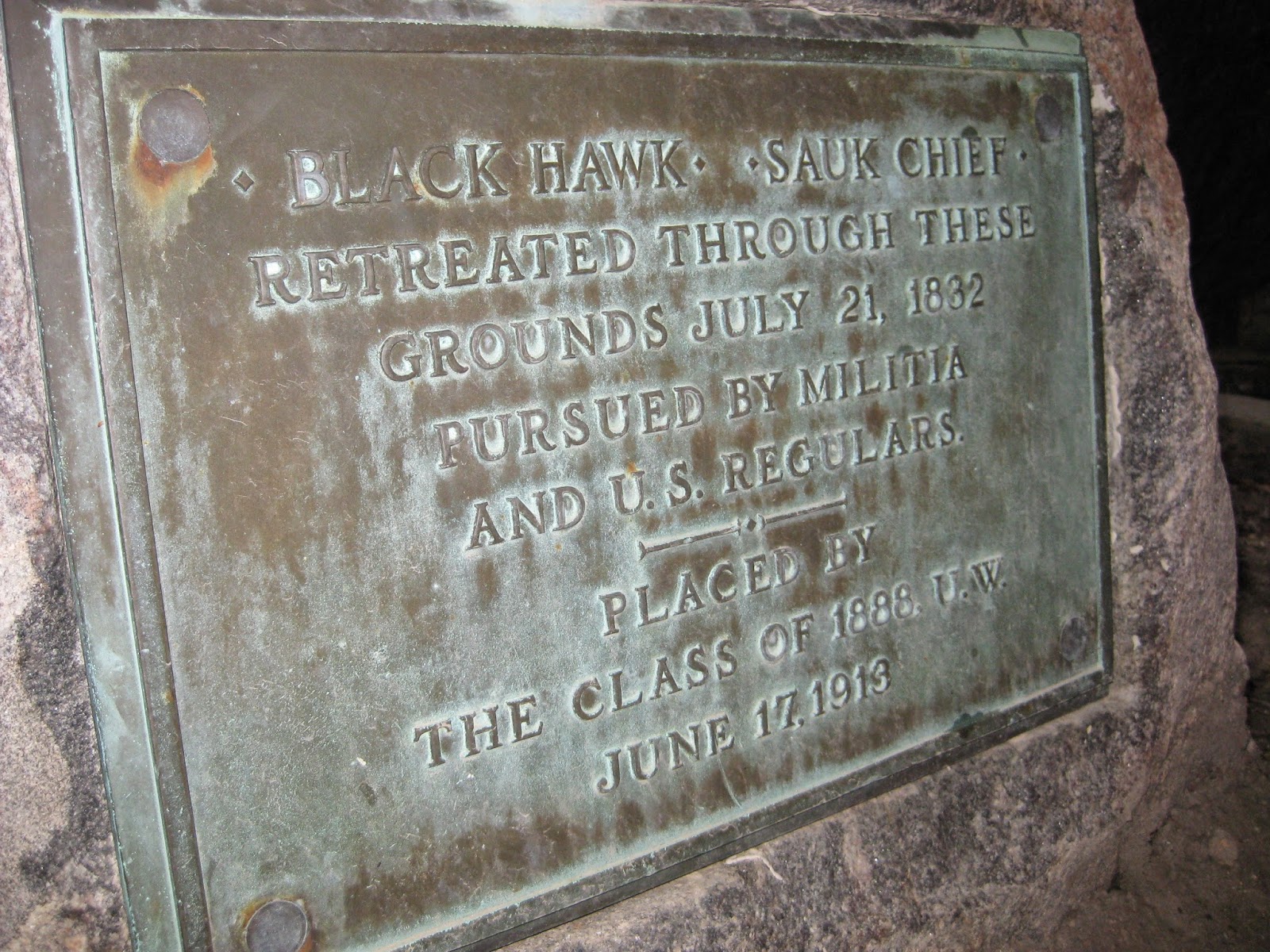
Historical Marker located on Bascom Hill
U.W. Madison Campus
Awakening, on the morning of July 20th, 1832, to another cloudy and windy day, Black Hawk and his people fled further to the west, finally crossing the isthmus between the two largest lakes, passed over and through the area which is now the University of Wisconsin, moved around Lake Mendota’s edge past what is now Marshall Park, and then straight north to a high mound standing alone among the waving grasses and sedges.  Along this track, today’s traveler will pass both the marker on Bascom Hill noting Black Hawk’s passage, and the Black Hawk Country Club, just one more eponym in tribute of the warrior.

Just west of Lake Mendota and northeast of Middleton, at the Pheasant Branch Conservancy, lies a solitary mound that rises elegantly from the surrounding fields like the oak-covered yolk of a vast brown egg.  The hill is dotted with white oaks, in numbers that could be easily counted if it were important, but it isn’t.  Visitors to this site, so close to the bustle of city life and yet so distinctly apart from it, are immediately infused with a sense of the openness of the prairie, the ancient subtext and undisturbed history of the site, and of the austere majesty of the hill that is the focal point of this large conservancy.

In the parking lot, we met a fellow traveler.  “Just in time for the rain”, he said.  We asked if he had ever heard about Black Hawk.  “Oh yes”, he said, and he proceeded to tell us a bit about what he knew on the subject.  “There’s more to the story”, I said.  I shared with him a few more details, and told him a little about our journey from Saukenuk/Rock Island.  We wished him well and began our walk to the top of the hill.  All along the way, we met people who were walking or jogging, enjoying what was a fairly pleasant late winter day.  We spoke to only one other person along the trail, an adolescent boy who told us that he didn’t’ know where the Indian Mounds were located, but that there was a great view from the top of the hill.  Indeed there was.

It is not difficult to see why Black Hawk chose this particular hill to set up camp on this night.  The previous night had been one of intense misery for the fugitives.  I have already described their extremely depleted physical condition and torturous flight through the thickets and swamps, but the night of July 19th, 1832 was one of howling west winds, violent thunderstorms, lightning, and localized flooding.  Demoralized, dispirited, and utterly without resources, they were forced to find whatever shelter they could and pass a fitful night resting with the wariness of a wounded, hunted animal.  They knew well from the scouts and rear guard that their pursuers were only a few miles behind them and rapidly catching up.


Mound at Pheasant Branch Conservancy
Middleton, WI

No doubt, the band received some guidance from the Ho-Chunk residents of the area, which was called Dejope in their native tongue, literally meaning ‘Four Lakes’.  From the top of the mound it is possible to see many miles in all directions, and it certainly would have been possible to see the approach of any group of people, be they friend or foe, without leaving the shelter of the trees.  This clear line of visibility was important to the weary survivors because their pursuers were now so close behind them that Black Hawk had set up an ambush using many of the able-bodied warriors back on the isthmus, and there were fewer warriors left to protect the non-combatants as they slept.  Secondly, the hill provided relatively dry conditions for the people to collapse in their fatigue.  Third, it was possible to house and hide a large number of horses on the far side of the hill from which their enemy would approach.  It was not the only location where the fugitives camped that night (many places where fires had burned the night before were discovered by troops the next day), but it is one that displayed Black Hawk’s keen abilities as a military strategist.


That night, at least one sad task was performed beyond mere survival.  At the encampment near Pheasant Branch, a single burial site was discovered of an Indian woman who had apparently died there.  The soldier who mentions it, notes only that the woman was “supposed to have died the night before”.  I don’t know if it was decency, shame or cowardice that prevented the soldier from describing how they came to the conclusion that the fresh mound of earth contained the body of a woman, and not that of a man.  I can only surmise that in pursuit of yet another coveted scalp, the grave was desecrated, and the body brought to the surface.

Though the Sauk expected battle that night, the armed troops never advanced as far as the ambush set up by Black Hawk and his warriors along the banks of the Yahara River, and they left the area well before dawn, once again fleeing to the west.  This day, the 21st of July, woke with a cold east wind, steadily falling temperatures, and a mist that turned to steady rain.  When the soldiers arrived at the Pheasant Branch encampment, the fires were cold, but the trail was hot. Black Hawk had eluded them one more night, but it would not last another day.


Makataimeshekiakiak – the fires of your people burned in this place long ago, to offer light and warmth in your time of need. It was fitting that you stayed here, among the spirits of the ancient mound builders, protected for the night.  It was fitting that for one more night, your people were able to regain enough humanity to bury this woman – this victim – with honor.
Today it is cold, and damp, and rain threatens but it does not fall.  Today the marsh is beautiful.  Today I walk along the paths, listening to the whispers of the dawning promise of spring, with the Swamp Sparrows nesting, and the Redwing Blackbirds shrieking their warnings.  Today I stand on the hilltop and look out over the lake, and the fields, and the marshes.  Today I remember the woman who died here, and was buried here to return to our Mother Earth.  Today I hold hands with my loved one and smell the rich damp soil, and the fresh, cold spring water, listening to the sounds of the earth and the sky.  Today I stand where you stood, and I walk where you walked.  I hope that you are able to come back to visit this place.  It looks now how it looked 182 years ago when you passed through.  It is a place of refuge among the people who now inhabit De Jope, and is protected by them.  The springs are still pure, and the birds still sing here in the springtime.  Your spirit is welcomed here.  May you and your people be free to walk these lands now and forever, exactly as they are now, exactly as they have always been,  and I pray, exactly as they shall forever remain.  Ah-ho.


(Key Terms: Ma-Ka-Tai-Me-She-Kia-Kiak, Black Sparrow Hawk, Black Hawk, 1767, Saukenuk, Pyesa, Rock Island, Black Hawk’s Watch Tower, Black Hawk State Historic Site, Hauberg Museum, Sauk, Sac, Meskwaki, Fox, Rock River, Sinnissippi River, Mississippi River, War of 1812, British Band, Great Britain, Treaty of 1804, Treaties, Ceded Land, William Henry Harrison, Quashquame, Keokuk, Fort Armstrong, Samuel Whiteside, Black Hawk War of 1832, Black Hawk Conflict, Scalp, Great Sauk Trail, Black Hawk Trail, Prophetstown, Wabokieshiek, White Cloud, The Winnebago Prophet, Ne-o-po-pe, Dixon’s Ferry, Isaiah Stillman, The Battle of Stillman’s Run, Old Man’s Creek, Sycamore Creek, Abraham Lincoln, Chief Shabbona, Felix St. Vrain, Lake Koshkonong, Fort Koshkonong, Fort Atkinson, Henry Atkinson, Andrew Jackson, Lewis Cass, Winfield Scott, Chief Black Wolf, Henry Dodge, James Henry, White Crow, Rock River Rapids, The Four Lakes, Battle of Wisconsin Heights, Benjamin Franklin Smith, Wisconsin River, Kickapoo River, Soldier’s Grove, Steamboat Warrior, Steamship Warrior, Fort Crawford, Battle of Bad Axe, Bad Axe Massacre, Joseph M. Street, Antoine LeClaire, Native American, Indian, Michigan Territory, Indiana Territory, Louisiana Territory, Osage, Souix, Potawatomi, Ojibwe, Ottawa, Ho-Chunk)